The Best Way to Clean Windows Outside: A Step-by-Step Guide for Stuart, Palm City & Treasure Coast Homes
Key Takeaways
- The best way to clean windows outside depends on weather timing, tool choice, and the order you clean in, not just the cleaner you use.
- Florida’s humidity and hard water start forming new mineral spots on glass within days of a DIY clean.
- Ladders cause hundreds of thousands of injuries every year in the US, making upper-story windows one of the riskier weekend jobs at home.
- A proper clean covers frames, sills, tracks, and screens, not just the glass itself.
- Soft washing from Magic Bubbles keeps the frames, sills, screens, and exterior around your windows clean from the ground, without harsh pressure on delicate surfaces.
Streaky glass, cloudy corners, and a hazy film that shows up again a week after you cleaned it. If that sounds familiar, you are not doing anything wrong so much as fighting the wrong battle.
Most people clean outdoor windows the way they clean indoor ones: spray, wipe, done. Outside, that approach almost never holds up, especially here on the Treasure Coast, where humidity, salt air, and hard water work against you every single day.
The good news is that the right method changes everything. Get the tools, the order, and the timing right, and your windows stay clear far longer. Get it wrong, and you are back on a ladder next weekend.
Below is the correct step-by-step way to do it, why Florida makes it harder than it looks, and how a professional soft wash from Magic Bubbles keeps the frames, sills, screens, and surrounding exterior clean, so the glass-cleaning work you do yourself actually lasts.
What’s Actually the Best Way to Clean Windows Outside?
The short answer: work in mild, overcast weather, rinse the surface before you touch it with anything, clean frames and sills before the glass, and finish with a squeegee instead of a rag. Each of those steps solves a specific problem that a quick spray-and-wipe leaves behind.
Most streaking happens for one of two reasons. Either the glass dried too fast in direct sun, or dirt from the frame got dragged across clean glass. Fix the order and the timing, and the streaks mostly disappear on their own.
Why Do Your Windows Look Hazy Again Just Days After You Clean Them?
This is where the Treasure Coast works against you. Florida holds some of the highest average humidity in the country, with statewide relative humidity averaging 70 to 80 percent and summer dew points routinely in the high 60s and 70s, according to the Florida State Climatologist’s Office at FSU. That moisture never really lets glass dry clean; it just gives dust and pollen something to stick to.
Add hard water into the mix. Florida’s groundwater runs through limestone aquifers, and much of the state’s water tests above 180 parts per million in hardness, according to University of South Florida’s summary of USGS water data. Every sprinkler cycle or hose rinse near a window leaves behind mineral spots that bake onto the glass in the sun.
Salt air adds a third layer for homes closer to the water: a fine film that attracts moisture and keeps windows perpetually a little dirty, no matter how often you wipe them down.
Is Pressure Washing Safe for Glass, Screens, and Window Frames?
Not at full pressure, no. Standard pressure washing can crack window seals, force water behind screen frames, and strip caulking around glass, which is exactly the kind of damage homeowners are trying to avoid in the first place.
This is why soft washing exists as a separate method. It uses low pressure and a cleaning solution to lift dirt, algae, and film instead of blasting it off, which is safer for screen enclosures, stucco, and painted trim close to a window than a straight pressure wash would be. It is the method Magic Bubbles uses across its residential services, precisely because Florida homes have so many delicate surfaces sitting right next to each other: screen against stucco, stucco against trim, trim against glass.
Do You Really Need a Ladder to Clean Second-Story Windows Safely?
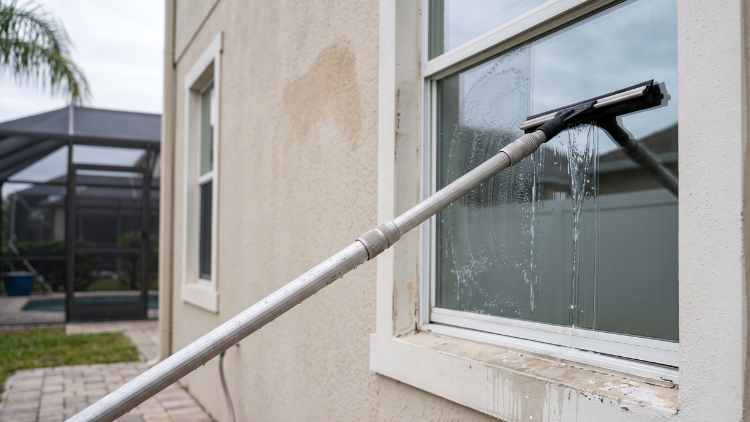
You do not, and honestly, you should try not to. Ladder falls send more than 500,000 people to the hospital every year in the US, and roughly 300 of those falls are fatal, according to CDC and NIOSH injury data.
Add in wet grass from morning sprinklers or an uneven paver patio underfoot, common on Treasure Coast properties, and the risk only goes up.
An extension pole with a squeegee head handles most second-story glass from the ground, which covers the DIY side of things.
For the frames, screens, and exterior surfaces around those same windows, especially on a full house, it is worth handing that part of the job to a professional instead of pushing your luck on a ladder alone.
The Right Way to Wash Outdoor Windows, Step by Step
Once the weather and tools are right, the process itself is straightforward:
- Pick the right conditions: Overcast skies, mild temperatures, and no wind. Direct sun dries cleaner too fast and leaves streaks behind before you can wipe it off.
- Rinse first: A plain hose rinse removes loose dust, pollen, and grit before you introduce any cleaner or cloth, so you are not grinding debris into the glass.
- Clean frames, sills, and tracks before the glass: Dirt from these areas is what usually ends up smeared across clean windows if you do it the other way around.
- Use a soft-bristle brush and a mild solution: Warm water with a few drops of dish soap works for most homes. Skip harsh, ammonia-heavy cleaners on tinted or coated glass.
- Squeegee in one direction: Work top to bottom in overlapping strokes, wiping the blade dry after each pass. Crisscrossing strokes are what cause most visible streaks.
- Rinse and dry the edges: A final light rinse clears soap residue, and a dry microfiber cloth on the corners stops water from pooling and leaving new mineral spots.
What a Professional Soft Wash Covers That DIY Usually Misses
Most DIY effort goes entirely into the glass, and understandably so, it is the part you actually look through. But algae, salt film, and dust build up just as fast on the frame, the sill, the track, and, on most Florida homes, the screen or pool enclosure around it.
Those surfaces rarely get touched with the same spray bottle and squeegee, and left dirty, they are exactly what re-coats freshly cleaned glass the next time it rains or a sprinkler kicks on.
Magic Bubbles’ residential soft washing services include house washing that safely cleans exterior surfaces like stucco, siding, and painted trim, along with dedicated screen enclosure cleaning that restores clarity to screens, frames, and structural components without damaging the materials underneath.
Keeping everything around the glass clean is what actually stretches out how long your own window-cleaning work holds up.
Keeping Your Windows Clear Between Visits on the Treasure Coast
A few habits stretch out the time between cleanings:
- Angle sprinkler heads away from windows so mineral spots do not build up on the glass.
- Rinse off salt spray or sprinkler overspray with plain water as soon as you notice it, before it has time to dry and bond to the surface.
- Trim back landscaping that brushes against screens or glass, since it traps pollen and moisture against the surface.
Final Takeaways
- Skip the ladder. An extension pole handles second-story glass from the ground, and a professional crew is the safer call for the frames, screens, and exterior around it.
- Always rinse first and clean frames and sills before the glass, not after.
- A squeegee used correctly beats a rag every time for a streak-free finish.
- If your windows haze over again within weeks, that is Florida’s water and air at work, not your technique.
Conclusion
Clean windows are one of those small details that change how an entire home looks from the street or the pool deck. Doing it right, in the right weather, in the right order, with the right tools, gets you most of the way there.
But on the Treasure Coast, humidity, salt air, and hard water mean even a perfect DIY clean has a shorter shelf life than it would almost anywhere else.
That is the gap Magic Bubbles’ soft washing fills: keeping the frames, screens, sills, and exterior surfaces around every window clean and free of the algae, salt film, and grime that undo a good glass cleaning within days.
Handle the glass with the method above, let Magic Bubbles handle everything around it, and you get your weekend back either way.
Frequently Asked Questions
How often should outdoor windows be cleaned in Florida?
Most Treasure Coast homes do well with a full exterior clean, windows included, every 6 to 12 months. Homes closer to the coast or under heavy tree cover tend to need it more often because of salt spray and organic buildup.
What is the best cleaner for outdoor windows to avoid streaks?
A simple mix of warm water and a few drops of dish soap works for most homes. Avoid strong ammonia-based cleaners on tinted or coated glass, and always finish with a squeegee rather than a cloth for the cleanest result.
Can I pressure wash my own windows?
You can, but standard pressure washing is risky on glass and screens because it can crack seals or force water behind frames. A garden hose rinse combined with hand cleaning and a squeegee is the safer way to handle the glass yourself. For the frames, screens, and exterior surfaces around the window, professional soft washing is the safer choice for a deeper clean.

Magic Bubbles
http://magicbubblestc.comMagic Bubbles Pressure Washing is a locally owned Magic Bubbles franchise serving Martin and St. Lucie Counties on Florida’s Treasure Coast. We’re licensed and insured and clean homes and businesses from Stuart, Palm City and Jensen Beach to Port St. Lucie and Fort Pierce. Our posts cover what local heat, humidity and coastal air do to roofs, pavers, pool cages and gutters, and how to keep them looking cared for.