Signs of Clogged Gutters on Your Home and the Damage They Cause

Key Takeaways
- Water spilling over the gutter edge during rain is usually the first visible sign of a clog.
- Dark streaks, sagging troughs, and plant growth often mean the problem has been building for months.
- Ignored clogs lead to rotted fascia, stained siding, cracked walkways, roof edge leaks, and standing water that attracts mosquitoes.
- Martin and St. Lucie County homes clog faster than most due to daily summer storms, hurricane debris, and constant tree litter.
If you live in Martin or St. Lucie County, your gutters work harder than gutters almost anywhere else in the country. Between daily summer downpours, hurricane season debris, and a steady supply of palm fronds, oak leaves, and pine needles, a clean gutter system can turn into a clogged one faster than you’d expect.
The tricky part is that clogged gutters rarely announce themselves. There’s no alarm, no warning light; just a slow buildup that quietly damages your fascia, siding, roof edge, and even your foundation while you go about your week.
The good news is that a clogged gutter almost always leaves clues before it causes serious harm. Below is a full breakdown of the warning signs, what each one leads to if ignored, and why Treasure Coast homes are especially prone to clogging. We’ll also cover how Magic Bubbles helps homeowners and property managers across Martin and St. Lucie Counties clear gutters and wash away the stains that overflow leaves behind.
What does water spilling over your gutters during rain actually mean?
If you notice a sheet of water pouring off the edge of your roofline instead of draining through the downspout, your gutter is full. It could be packed with leaves, seed pods, or granules from your shingles, all of it blocking the water’s path.
This is usually the easiest sign to catch, since it happens in real time during a storm. In Martin and St. Lucie Counties, where afternoon thunderstorms are a near-daily summer occurrence, a gutter that overflowed once this week can overflow again within days if the debris isn’t cleared.
Watch the roofline the next time it rains. If water is falling in a curtain rather than a steady trickle from the downspout, that section of gutter needs attention soon.
Why do dark streaks and mildew stains show up on your fascia and siding?
When gutters overflow, water doesn’t fall straight down; it runs down the fascia board and siding beneath it, carrying tannins from decomposing leaves and organic debris. In Florida’s humidity, that damp, nutrient-rich film turns into mildew and algae within weeks.
This is why you’ll often see vertical dark streaks below the gutter line, even on sections of siding that look clean everywhere else. It’s a strong indicator that the overflow has been happening repeatedly, not just once.
If you spot these stains, check the gutter directly above them. There’s a good chance it’s holding standing water or packed debris right at that spot.
What causes gutters to sag, pull away, or grow plants and moss?
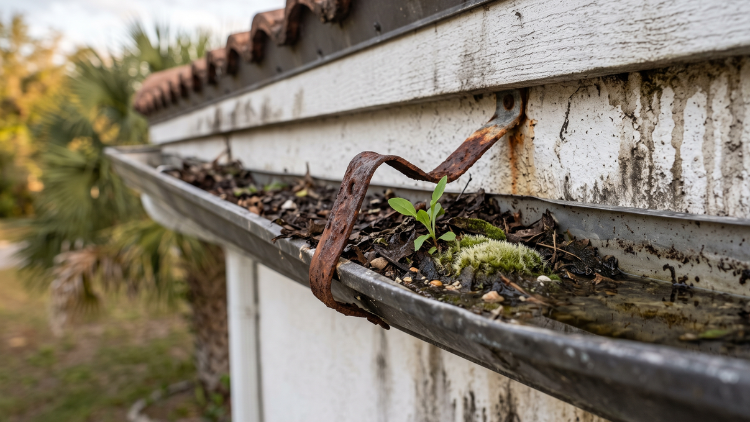
Gutters are built to hold water in motion, not water and debris sitting still. When leaves, twigs, and sediment pile up, the added weight strains the hangers that hold the gutter to your fascia board, causing it to sag, pull loose, or pitch at an angle.
Over time, trapped organic material becomes its own tiny ecosystem. Seeds sprout, moss takes hold, and small plants can actually grow directly out of the trough. If you see greenery growing from your gutter line, the clog beneath it has likely been there for a long time.
A sagging or visibly uneven gutter line is also a safety concern, since a gutter that fails can pull away from the roof and fall.
The hidden damage clogged gutters leave behind
Every sign above points to the same underlying problem: water that should be flowing away from your home is being trapped or misdirected instead. Left alone, that trapped water works its way into the structure itself.
Fascia and soffit boards are usually the first casualties, since they sit in direct contact with overflowing water and can rot from repeated soaking. Stucco and siding pick up staining and mildew growth close behind. Concrete driveways and walkways near downspouts can crack or shift as saturated soil beneath them settles unevenly, and along the roofline, trapped water can back up under shingles or tile and work its way into the foundation area over time.
There’s also a health and comfort angle that homeowners often overlook. Standing water left in a clogged gutter is exactly the kind of stagnant pool mosquitoes need. Health agencies note that mosquitoes can breed in surprisingly small amounts of standing water, which is why keeping gutters clear is a recommended step for reducing mosquito activity around a property. In our climate, a clogged gutter after a storm can turn into an active breeding site within days.
None of this happens overnight, and that’s precisely the risk. Each sign feels minor on its own, but together they represent a slow, compounding decline that gets more expensive to fix the longer it’s ignored.
Why Martin and St. Lucie County homes clog faster than most
Not every region puts the same stress on a gutter system. The Treasure Coast is a humid subtropical climate with daily sea breeze thunderstorms through the summer, and St. Lucie County alone receives about 52 inches of rain a year on average. That’s a lot of water moving through your gutters, over and over, all season long.
On top of that volume, our local tree canopy adds a steady stream of debris. Oak leaves, pine needles, and palm fronds shed year round rather than in a single fall season, so gutters that might get cleaned once or twice a year elsewhere in the country need more frequent attention here.
Hurricane season adds another layer. Even storms that stay offshore can knock loose branches, palm debris, and roofing grit into your gutters in a single afternoon. Combine that with our salt air and near-constant humidity, and trapped debris turns into mold and algae far faster than it would in a drier climate.
For homeowners and property managers with multiple properties across Stuart, Palm City, Port St. Lucie, Fort Pierce, and the surrounding area, this means gutter maintenance isn’t a once-a-year task. It’s an ongoing part of protecting the property.
How Magic Bubbles clears gutters and restores your home’s exterior
This is exactly the gap Magic Bubbles is built to close for Martin and St. Lucie County homeowners and property managers. Their gutter cleaning service removes leaves, debris, and built-up buildup so rainwater can flow away from your property the way it’s supposed to, which matters most heading into Florida’s rainy season.
Beyond gutters, Magic Bubbles also offers house washing to lift mildew and algae stains from stucco and siding, roof soft washing to remove black streaks safely from shingles or tile, and driveway, sidewalk, patio, and paver cleaning for concrete and hardscape surfaces around the property. Deck and fence cleaning and screen enclosure cleaning round out their residential lineup, so homeowners and property managers have one local company to call for exterior upkeep in general, whether or not it’s tied to a gutter issue.
For homeowners and property managers who’d rather not track this on a calendar, Magic Bubbles also offers membership plans, with scheduled cleanings that can cover roofs, driveways, patios, and gutters throughout the year. Every service comes with a free, no-obligation quote, and the team is licensed and insured for work across Stuart, Palm City, Jensen Beach, Port St. Lucie, Fort Pierce, and nearby communities.
Final Takeaways
- If you’re noticing two or more warning signs at once, streaks, sagging, and pooling together, the clog has likely been building for months, not weeks.
- Waiting until after a storm or hurricane season is over usually means dealing with repairs instead of preventing them.
- Homes with heavy oak, pine, or palm coverage need more frequent gutter checks than the standard twice-a-year rule.
Conclusion
Clogged gutters rarely cause damage all at once. It happens sign by sign: an overflow here, a streak there, a little erosion near the foundation, until one day it adds up to a real repair bill. The upside is that every one of these signs is easy to spot from the ground once you know what you’re looking at, and easy to fix before it turns into something bigger.
For homeowners and property managers across Martin and St. Lucie Counties, staying ahead of gutter clogs is one of the simplest ways to protect a home’s structure, curb appeal, and value. Magic Bubbles makes that easy with gutter cleaning, soft washing, and exterior care handled by a local, licensed, and insured team, so your home stays protected through every Treasure Coast storm season.
Frequently Asked Questions
How often should gutters be cleaned in Martin and St. Lucie County?
Most homes here benefit from cleaning at least twice a year, with an extra check before hurricane season. Properties with heavy oak, pine, or palm coverage often need more frequent attention since debris builds up year round rather than in a single season.
Can clogged gutters really damage my foundation?
Yes. When water overflows in the same spot repeatedly, it saturates the soil next to your home instead of draining away from it. Over time, that saturation can lead to soil erosion, settling, and cracks in nearby concrete or foundation walls.
Do clogged gutters really attract mosquitoes on the Treasure Coast?
They can. Mosquitoes need very little standing water to lay eggs, and a clogged gutter after a rainstorm can hold water for days in our humid climate. Clearing gutters regularly removes one of the easiest breeding sites around a home.